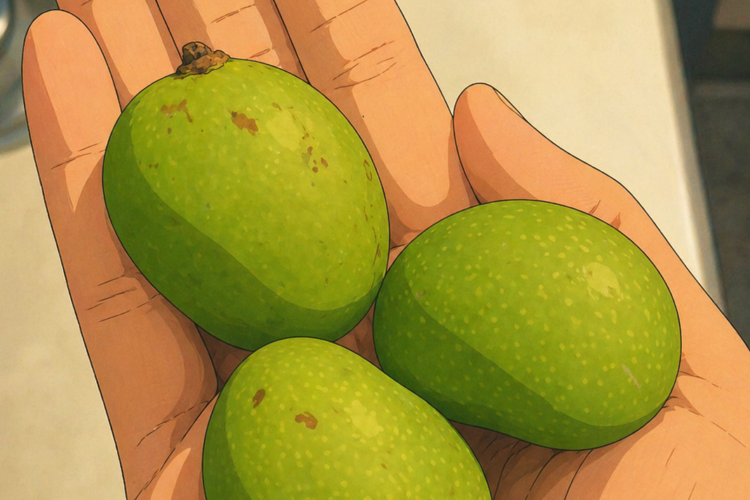
Every year, sometime in March or early April, the mangoes arrive. Not the ripe ones – those come later, golden and yielding and sweet enough to eat standing over the sink with juice running down your wrists. These are the raw ones, hard, green, and sour, smelling of something sharp and alive. And every year, without fail, something in me goes very quiet when I see them piled up at the market.
I am six years old again. It is summer holidays. And there is nowhere in the world I would rather be than my grandparents’ house, where I spent most of my childhood.
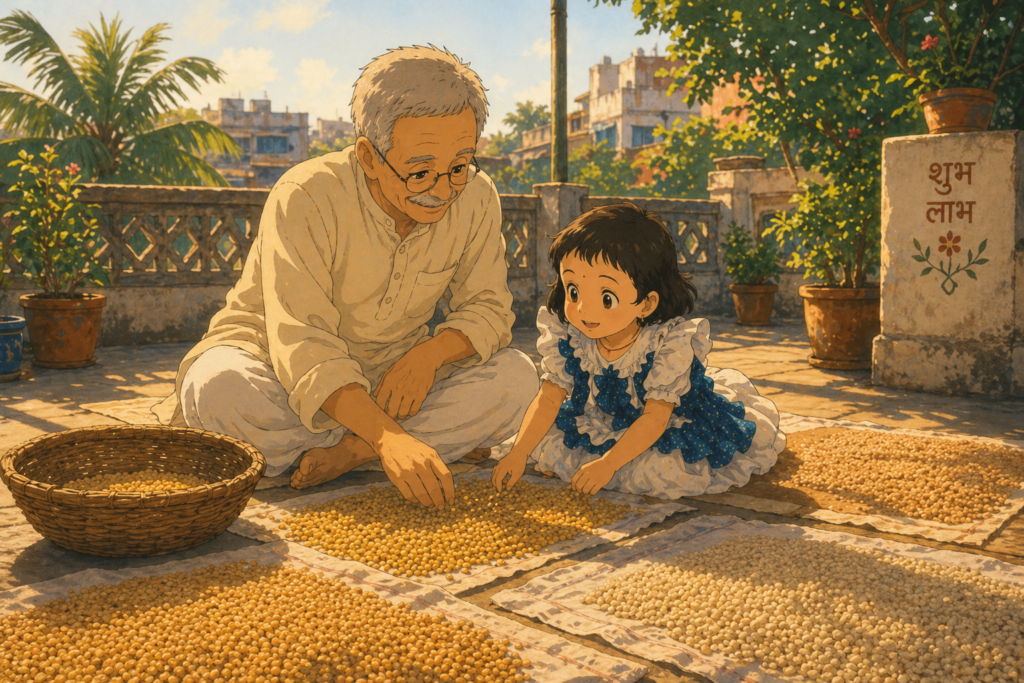
Summer holidays in an Indian household back then weren’t quite the lazy stretch of nothingness, there was work – a particular, seasonal, entirely serious work that I understood only vaguely as a child but can now see was the whole point of the season. Every summer, the grains and lentils came out. Rice, wheat, jowar, bajra, toor dal, moong, masoor – the year’s worth of food laid out on the terrace in the early morning hours, spread across old bedsheets and reed mats, to be dried in the sun and cleaned and kept safe. My grandpa would be up there before anyone else, barefoot on the warm concrete, and I’d trail up after him still half-asleep. He’d spread the grain in careful rows and I’d watch, or help with the smaller lentils, scooping them with both palms pressed together. He had a patience I have never been able to replicate – picking through the dal with quiet fingers, removing stones and husks, knowing by the feel of a handful whether it had too much moisture. He’d been helping my grandma with this yearly chore ever since they got married.
Sun-dried dal has a smell I have never been able to adequately describe – warm and earthy and faintly nutty, the smell of something being kept safe. It lives in me the way only childhood memories do.
Meanwhile, my grandma’s kitchen was its own world. Summer was when it truly came alive. Large ceramic jars lined the shelves – mango pickle, lemon pickle, muramba, chunda. Raw mangoes arrived in gunny sacks, and she’d sit on the kitchen floor for entire mornings sorting and cutting, the air thick with mustard oil and hing and red chilli powder. Papad were rolled and dried on racks on the terrace alongside the grain. Spices were dried and ground fresh, the whole house smelling of coriander and dried red chillies laid out on newspaper by the window. Tulsi leaves were tucked into grain containers, something about the oils that kept insects away, and mercury tablets went into the lentil storage, every jar then sealed with cloth and twine – there was a science to all of it.
And then, when the morning work was done, summer truly began.
We played until we were called in, which was never early enough. Hide-n-seek, freeze tag, badminton, langdi, and viti-dandu on the terrace after the grain was safely stacked away. Then there were long slow hours of doing absolutely nothing in the shade of the verandah while the afternoon pressed down on everything outside. And through all of it – the playing, the resting, the falling asleep in odd places, the waking up sticky and disoriented – there was always something cold and sweet waiting in the kitchen.
Kairi panha. Made fresh every morning in a large steel vessel, raw mango boiled and pulped and mixed with jaggery, roasted jeera, and cardamom. We’d pour tall steel glasses of it and drink standing at the counter, still breathless from whatever game we’d abandoned.
Then there was the kulfi wale uncle. Five o’clock, without fail – you’d hear the bell before you saw him, a tin-tin-tin that travelled down the lane and into the house and directly into the chest of every child who heard it. He knew all of us by name and preference. Keshar pista kulfi for me, always, unwrapped from a small earthen pot, handed over with the mild indifference of someone who has been doing this for more than twenty years. I don’t remember when he stopped coming. He just did, the way things from childhood do – without announcement, without ceremony, just quietly absent one summer and then every summer after. Today I can have kulfi delivered to my door in twenty minutes, from three different apps, in twelve different flavours. It is perfectly fine kulfi. But the thing I actually want – the bell in the lane, the running downstairs with coins in a sweaty fist, the sense of having been known by name – that doesn’t come with any of them.
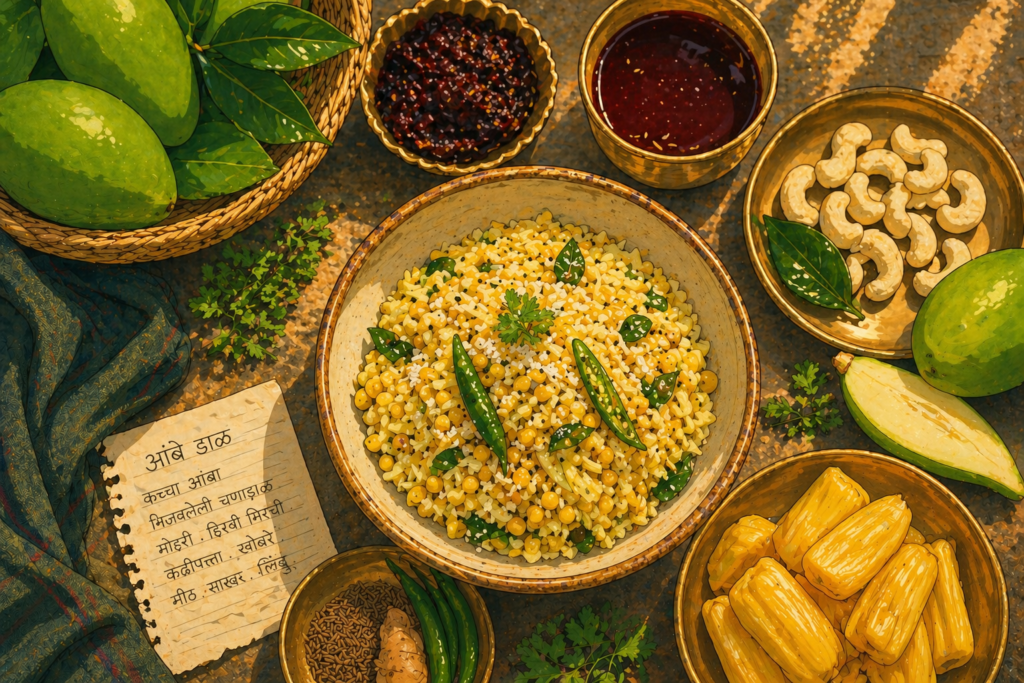
The food of a Maharashtrian summer is its own kind of joy, and I say this as someone who loves food from everywhere. Ambe dal, raw mango grated and mixed with soaked chana dal, tempered with mustard seeds and green chilli, finished with fresh coconut, was made almost every week, cold and faintly nutty, eaten with everything as a side-dish or alone with a spoon. Kokum sharbat: deep purple-red, intensely sour, with a pinch of salt and roasted jeera, the kind of thing that actually cools you down rather than just tasting cold. Jackfruit sabzi, slow-cooked until it gave up its fibres entirely, tender and meaty in a way that takes patience and time. And ola kaju usal (raw cashew curry) made only in the few weeks when fresh cashews arrived from the Konkan coast, tender and milky and nothing at all like what we eat roasted and salted the rest of the year. Miss the window, wait a whole year.
I don’t make all of this anymore. I have a busy career. I have a life that moves at a pace my grandma’s never did. I order groceries online. I buy pickles in jars. I have never once spread grain on a terrace to dry in the sun and I probably never will.
But when raw mangoes arrive, I make ambe dal. On one of those really hot days of the year, I make kairi panha with jaggery, not sugar, with roasted jeera, the way it was always made. I keep dried kokum in my pantry all year and there is always a ceramic jar of something pickling on my kitchen shelf, even if it’s shop-bought and I’ve just transferred it into a nicer container because I like the way it looks.
Traditions survive not because we preserve them whole, but because enough of us keep enough of them alive – imperfectly, incompletely, between everything else that demands our time. My grandma spent entire summers putting food away for the year. I spend an afternoon, once in a while, making one thing from her kitchen.
It’s not the same. But it is something. And some years, when the mangoes arrive and something in me goes quiet, it feels like quite a lot.
What’s your summer food memory? I’d love to hear it in the comments – the more specific, the better. 🥭
AMBE DAL (RAW MANGO & CHANA DAL SALAD)
Ingredients
Method
- Soak the dal: Wash chana dal and soak in water for 2–3 hours. It should soften but retain a slight bite – you want texture, not mush. Drain completely.
- Grate the mango: Peel and grate on a coarse grater. Squeeze out excess juice if very wet.
- Mix: Combine drained dal, grated mango, coconut, green chillies, and coriander. Add salt and jaggery if using. (Taste: it should be tart, slightly sweet, nutty, and fresh.)
- Make the tadka: Heat oil, add mustard seeds and wait for them to splutter. Add cumin, curry leaves, hing, and dried red chilli. Sizzle for 30 seconds.
- Pour tadka over the dal mixture and toss well.
- Serve immediately at room temperature or slightly chilled.
Notes
- Mango: Use a firm, very sour raw mango, the sourer the better.
- Dal texture: Firm and slightly crunchy. Over-soaked dal turns mushy and loses its character.
- Coconut: Fresh is traditional and strongly recommended. Desiccated works in a pinch but loses freshness.
- My grandma’s version: She never added jaggery. Start without it and taste first.
Если вы хотите [url=https://www.dizaynerskiye-barnyye-stulya.ru/]барные стулья премиум класса[/url], наш магазин предлагает широкий выбор стильных и качественных моделей. Кроме того, в некоторых…
qkyuopnmtxsunydrjxsyipwtvtyozu